
Archaeology
Learning about the Priory through recovered stones, bones and artefacts.
The first archaeological dig of the Priory was undertaken ‘unknowingly’ during the 1880s, when workmen were constructing the new railway line. Mediaeval, church like stonework was uncovered indicating the location and layout of Launceston’s ‘lost’ mediaeval Priory.
At that time local historians, Richard and Otho Peter got involved and provided detailed reports, maps and drawings. There have been ten archaeological digs linked to Launceston Priory with reports from 1893 to 2012 registered with the ‘Archaeological Data Service’. There is a link further down on this tab.
Their combined findings and further in depth research have provided us with the architectural and situational knowledge to be able to describe the medieval buildings and how the surrounding area was used with confidence. Maps, drawings and models describe the extent and work of the Priory when it was active.
Launceston Town Council now owns and maintains the part of the site exposed.
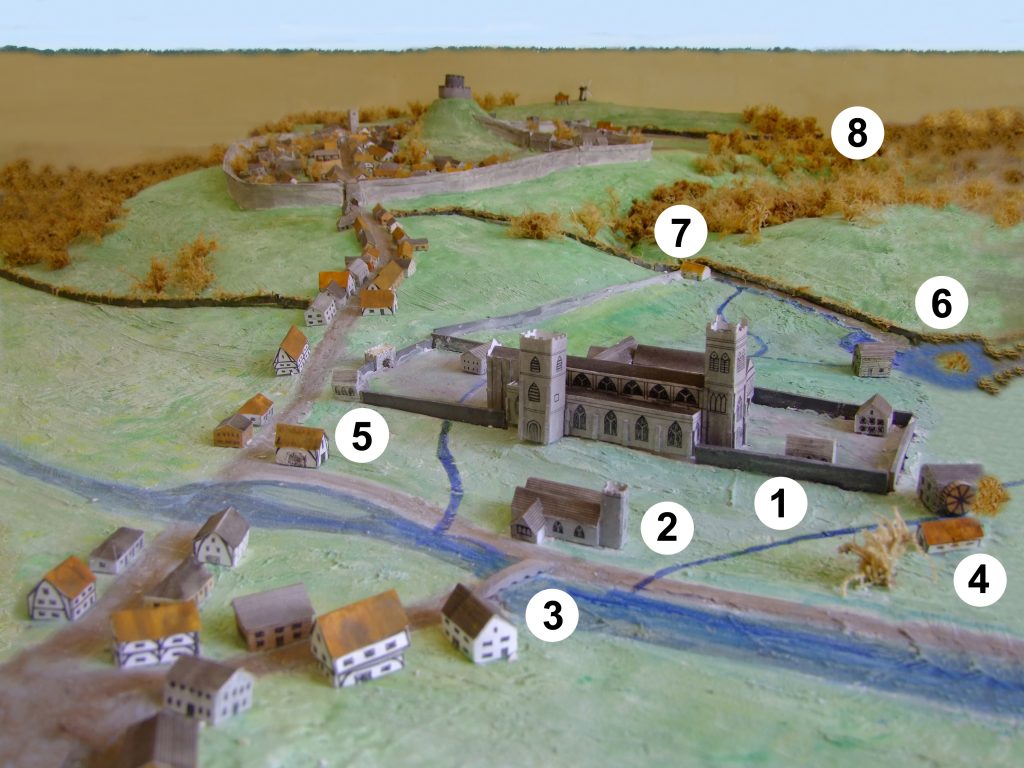
This is a model of Launceston as it was in 1530, which was just before the Dissolution in 1539. It was constructed by Samuel Lunt, and was presented to Launceston’s Lawrence House Museum in 1993 and is on display along with numerous artefacts from the Priory.
It is photographed and annotated for us by John Ellacott .
Further reading and illustrations;
Reports from archaeological digs.
The report of our archaeological dig, July 2019 will be here in due course. For now please see our events tab.
Here is a link to the full and Final Report, 2011, of Launceston Priory, Launceston, Cornwall Clearance and archaeological recording in advance of consolidation. This archaeological dig and report was organised by Launceston Town Council and funded by them, Cornwall Council and the Heritage Lottery Fund. file:///C:/Users/Priory/Downloads/2009R047.pdf cornwall2-97403_1.pdf (11 MB) :Download If you have an interest in the Priory’s window shapes we suggest you scroll to almost the end of the report for drawings based on the stone remains. Cornwall Archaeology and James Gossip, BA, MFA have given permission to display their report.
Other reports about the Priory are listed here and some can be opened from this link; https://archaeologydataservice.ac.uk/library/search/searchResults.xhtml Other, mostly older documents will be available later this year at Kresen Kernow; https://www.cornwall.gov.uk/community-and-living/records-archives-and-cornish-studies/kresen-kernow-cornwalls-new-archive-centre/ To view some documents, you may have to travel to Kresen Kernow, which is in Redruth.
In 927 King Athelstan had a major influence on the development of the community at Lanstephenton (now St Stephens) when he and his Witan (a group of wise man who advise the King) camped in Lifton, which is over the river Tamar and in Devon. Each Witan will have had many servants with them and so the camp will have been of some considerable size.
To establish where in Lifton they camped, two sites have been explored. Devon County Council’s interactive map shows both of the potential sites. You will need to read and ‘accept’ a disclaimer and then zoom in to Lifton’s Castle Farm and then Lifton Wood.
http://map.devon.gov.uk/dccviewer/?bm=OSGreyscale&layers=Historic%20Environment;0;1&activeTab=Historic%20Environment&extent=210064;27188;338387;150088
Both sites are on private ground and not accessible to the public.
Initially the site for the Witan camp was thought to be at Castle Farm;
https://www.heritagegateway.org.uk/Gateway/Results_Single.aspx?uid=MDV3900&resourceID=104
https://historicengland.org.uk/listing/the-list/list-entry/1017968
More recently it is thought to be at an older hill fort in Lifton wood;
https://www.heritagegateway.org.uk/Gateway/Results_Single.aspx?uid=MDV108533&resourceID=104
file:///C:/Users/Launceston%20Priory/Downloads/Hilltop%20Enclosure%20at%20Lifton.pdf Bill Horner, Devon County Archaeologist has provided this information for our website.
Archaeology for all. The Council for British Archaeology.
http://new.archaeologyuk.org/
We welcome your contact to; ask anything about this website or our events or to book a talk or guided walk; suggest ideas for our website or future events; offer to help with our ‘to be developed topics’ or to join our committee. Please see our Contact tab.Thank you. 😊